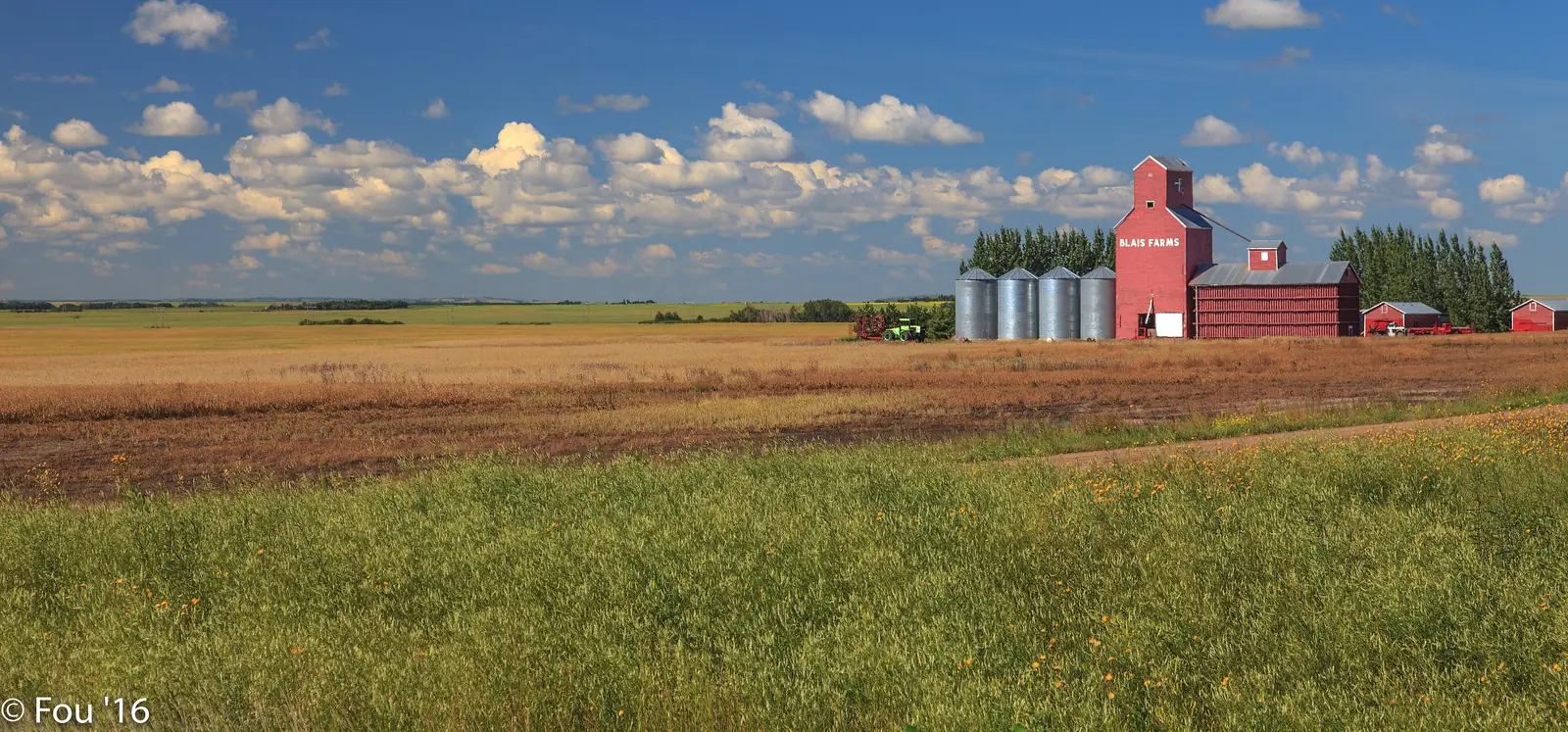
A red wooden grain elevator and steel bins beside a harvested field under a big blue Saskatchewan sky
Farming in Canada

From the Pacific to the Atlantic to the Arctic.

Ten provinces and three territories, each with its own crops, climate and rules. Here is what is farmed where, what the seasons look like and where to find official help.

L’agriculture au Canada : un guide des 10 provinces et 3 territoires.

On the farm this season · October

Fall run Ventes d’automne

  • Fall calf sales at auction marts
  • Corn and soybean harvest in the east
  • Thanksgiving weekend (second Monday of October)
Handy tool for October Grain bin & silo capacity calculator

Coming up · November

Fall work

  • Soil testing and fall fertilizer where it suits
  • Cattle move home for winter feeding

Timing shifts by region and year: the Prairies, the coast and the Maritimes can be weeks apart.

Province by province

Five regions, thirteen ways to farm.

Jump to a region, or scroll through them all. Each card links to that government’s own agriculture page.

West Coast Côte Ouest

British Columbia

Colombie-Britannique

  • Tree fruit & grapes
  • Berries
  • Dairy & poultry
  • Greenhouse vegetables
  • Cattle ranching
What’s farmed
Apples, cherries and wine grapes in the Okanagan; blueberries, raspberries, cranberries, dairy, poultry and greenhouse vegetables in the Fraser Valley; cattle ranches across the Interior; grain and canola in the Peace River country.
Climate & season
The mildest winters in Canada on the coast, hot dry summers in the Okanagan (most orchards are irrigated), colder Interior plateaus and a short, Prairie-style season in the Peace.
Good to know
Much of BC’s farmland is inside the Agricultural Land Reserve (ALR), which limits non-farm uses. Check a property’s ALR status before you buy.
BC agriculture and seafood (official government site)

The Prairies Les Prairies

Alberta

  • Beef cattle & feedlots
  • Wheat
  • Canola
  • Barley
  • Irrigated crops
What’s farmed
Canada’s biggest beef cattle herd, with feedlots concentrated in the south; wheat, canola and barley across the province; irrigated sugar beets, potatoes, pulses and forages in the southern irrigation districts.
Climate & season
Dry in the south, where chinook winds bring warm spells in winter; wetter parkland in the centre; a shorter season in the Peace region in the north.
Good to know
Most of Canada’s irrigated farmland is in southern Alberta and is supplied through irrigation districts. Water rights matter as much as the land.
Alberta Agriculture and Irrigation (official government site)

Saskatchewan

  • Spring wheat & durum
  • Canola
  • Lentils & peas
  • Oats, barley & flax
  • Cattle
What’s farmed
The largest share of Canada’s cropland: spring wheat, durum, canola, lentils, peas, oats, barley, flax and mustard, with cattle on mixed farms and grazing land. Most of Canada’s lentils and durum are grown here.
Climate & season
Long, cold winters and short, hot, sunny summers. The southwest (Palliser’s Triangle) is semi-arid, so moisture usually decides the yield.
Good to know
Land is usually bought and rented by the quarter section (160 acres). Grain moves to inland terminals and elevators, so check the haul distance to your nearest delivery point.
Saskatchewan agriculture (official government site)

Manitoba

  • Wheat & canola
  • Soybeans & corn
  • Hogs
  • Potatoes
  • Oats
What’s farmed
Wheat, canola, oats, soybeans and corn, one of Canada’s largest hog sectors, potatoes grown for processing, and rich clay soils in the Red River Valley.
Climate & season
Very cold winters and warm, humid summers. The Red River Valley is prone to spring flooding after snowy winters.
Good to know
Winnipeg is home to the Canadian Grain Commission, which sets grain grades and licenses grain companies. It is the place to start if you have a grading dispute.
Manitoba Agriculture (official government site)

Central Canada Centre du Canada

Ontario

  • Dairy, poultry & eggs
  • Corn & soybeans
  • Winter wheat
  • Greenhouse vegetables
  • Tender fruit & grapes
What’s farmed
More farms than any other province: dairy, poultry and eggs, grain corn, soybeans and winter wheat, greenhouse vegetables around Leamington, tender fruit and wine grapes in Niagara, and beef farms in the east and north.
Climate & season
The Great Lakes give the southwest one of the longest growing seasons in Canada. Northern Ontario (including the Clay Belt) has colder winters and a much shorter season.
Good to know
Ontario’s agriculture ministry publishes free crop, livestock and farm-business guides: a good first stop for new farmers.
Ontario Ministry of Agriculture, Food and Agribusiness (official government site)

Quebec

Québec

  • Dairy
  • Maple syrup
  • Hogs
  • Corn & soybeans
  • Berries
What’s farmed
More dairy farms than any other province, most of the world’s maple syrup, a large hog sector, grain corn and soybeans in the St. Lawrence Lowlands, blueberries around Lac-Saint-Jean and cranberries in Centre-du-Québec.
Climate & season
Warm summers and long, snowy winters. Most farming is in the St. Lawrence Lowlands, where the season is longest.
Good to know
French is the official language of Quebec. Farmland is protected by the Commission de protection du territoire agricole (CPTAQ), so non-farm use or subdividing needs its approval.
Quebec agriculture ministry (MAPAQ) (official government site)

Atlantic Canada Canada atlantique

New Brunswick

Nouveau-Brunswick

  • Potatoes
  • Wild blueberries
  • Maple syrup
  • Dairy
  • Poultry
What’s farmed
Potatoes in the upper Saint John River valley, wild blueberries on the Acadian Peninsula, maple syrup (the second-largest producer after Quebec), dairy and poultry.
Climate & season
Cooler, damper summers than central Canada and snowy winters, moderated by the sea near the coast.
Good to know
New Brunswick is Canada’s only officially bilingual province, so government services and many buyers work in both English and French.
NB Agriculture, Aquaculture and Fisheries (official government site)

Nova Scotia

Nouvelle-Écosse

  • Wild blueberries
  • Apples
  • Dairy & poultry
  • Christmas trees
  • Grapes
What’s farmed
Wild blueberries, apples in the Annapolis Valley, dairy, poultry and eggs, balsam fir Christmas trees and a growing wine-grape sector.
Climate & season
A moderate maritime climate: cool summers, changeable winters and fog on the coast. The Annapolis Valley is the warmest farming area.
Good to know
Some of the best farmland is dykeland along the Bay of Fundy, first built by Acadian settlers and still protected by dykes and aboiteaux today.
Nova Scotia Agriculture (official government site)

Prince Edward Island

Île-du-Prince-Édouard

  • Potatoes
  • Dairy
  • Beef
  • Grains in rotation
  • Blueberries
What’s farmed
Potatoes are the island’s biggest crop, grown in rotation with grains and forages, alongside dairy, beef and wild blueberries.
Climate & season
Maritime: mild summers and snowy winters. The red, sandy soils drain well but are easily eroded, so rotations and soil cover matter.
Good to know
PEI’s Lands Protection Act limits how much land one person or company can hold, and crop-rotation rules apply to potatoes. Check both before buying or renting land.
PEI Department of Agriculture (official government site)

Newfoundland and Labrador

Terre-Neuve-et-Labrador

  • Dairy
  • Poultry & eggs
  • Root vegetables
  • Wild berries
  • Sheep & beef
What’s farmed
Dairy is the leading sector, followed by poultry and eggs, root vegetables, wild berries and small sheep and beef farms.
Climate & season
A cool, short season with rocky soils and strong maritime influence; good arable land is limited.
Good to know
Much of the province’s food is shipped in, and the province supports farmers who grow more locally. Ask about land and development programs before you start.
NL agriculture and agrifoods (official government site)

The North Le Nord

Yukon

  • Hay & forage
  • Market vegetables
  • Eggs
  • Small livestock
What’s farmed
Hay and forage, market-garden vegetables, eggs and small livestock farms, mostly around Whitehorse and in the valleys.
Climate & season
Subarctic: very cold winters and a short frost-free season, offset by very long summer daylight.
Good to know
Agricultural land is applied for through the Government of Yukon, and its Agriculture Branch gives free farming advice.
Yukon: get advice on farming (official government site)

Northwest Territories

Territoires du Nord-Ouest

  • Community gardens & greenhouses
  • Eggs
  • Potatoes
  • Wild harvest
  • Honey
What’s farmed
Community gardens and greenhouses in every region, commercial egg, potato and vegetable growers, market gardens around Hay River, honey, and wild harvests such as mushrooms and birch syrup.
Climate & season
Subarctic, with permafrost in many areas, long cold winters and almost round-the-clock daylight in midsummer.
Good to know
The territorial government publishes an agriculture sector profile and funding programs for small growers and farmers markets.
NWT agriculture sector profile (official government site)

Nunavut

  • Country food
  • Arctic char & seafood
  • Community greenhouses
What’s farmed
Very little conventional farming. Food comes from Inuit harvesting of country food (such as caribou, Arctic char and seal), fishing and a few community greenhouse projects.
Climate & season
Arctic: permafrost and tundra, a very short summer and long, dark winters.
Good to know
Country food and harvesting are central to Inuit culture and food security. Harvesting is led by local hunters and trappers organizations.
Nunavut Country Food Distribution Program (official government site)
Across Canada

A few things every Canadian farm shares.

Supply management

Dairy, chicken, turkey, eggs and hatching eggs are produced under provincial quota. Buying quota is often the biggest cost of starting in those sectors.

Acres and hectares

Canada is officially metric, but most farmers still talk in acres, bushels and pounds. Our grain converter and unit converter handle both.

Two official languages

English and French are both official languages of Canada. Federal programs are available in both, and French is the main language of farming in Quebec.

Who do I call? Farm help directory

Find a vet, agronomist or auction mart

This guide is general information to help you find your way, not professional advice. Rules and programs change, so always check with the official source. Spotted something out of date? Tell us.

Farming somewhere in Canada?

Use our free farm tools, or talk to the REALM team about machinery, livestock, land and finance.